Friday, February 8, 2013

Common Birds of Sweden- Eurasian Magpie

Gothenburg
Gothenburg is a city on the west coast of Sweden, with a an oceanic climate. During the summer, daylight extends 17 hours, but lasts only around 7 hours in late December. 

It is rather a green city, with many parks and nature reserves ranging in size from tens of metres to hundreds of hectares. Apart from these, the entire city has a decent green cover, with various trees and plants everywhere. One can find patches of thick woods right outside apartment buildings; roads are almost always lined with trees, good sized lawns in front of all apartments/villas. And most of these trees are fruiting trees. In short i can say there might not be a house which does not have a view of some trees and some green patch. 
A path through the woods right outside an apartment complex 
Also people here are bird-friendly. They do make it a point to have some nests, bird feeders and so on in their little gardens or even in their balconies. 

Owing to these, bird life is quite good here, with many species living in the urban gardens. One can always do some bird watching right from their windows or balconies, irrespective of the weather! In fact it is easier this way and more fruitful! It is amazing to see many birds that winter here in spite of the cold climate. 

Coming up here is a new series with posts about the common birds found here. Here's the first one.

Eurasian Magpie

One of the most common birds one sees in the city are Eurasian Magpies [Pica Pica]. I can say they are common mynas of Europe! They are seen everywhere - in balconies of houses, on lawns, in urban gardens, beside busy roads, in thick woods, and so on. They are highly adaptable and social. They feed on insects, other small birds, eggs, scraps, etc. They are also fond of processed food fed by humans, especially bread! 
The black, white and the iridescent shades 
It is a beautiful bird with with pure white and black colors with a metallic green and violet sheen on the wing feathers. The wings have white inner webs, conspicuous when the wing is open. The graduated tail is black, shot with bronze-green and other iridescent colors.  
A couple, foraging together
The Magpies are supposedly the most intelligent of birds. They have apparently the only bird to demonstrate mirror self recognition, hide food and remember food location, divide food equally among its chicks and so on. From my personal observation of these, I have seen that they visit places where they can possibly find food at the same time everyday. My neighbor here feeds them with scraps of bread occasionally and they wait outside the balcony everyday at around the same time!

The nest - a couple is making the nest ready during the end of winter when the tree is still barren
They do not avoid humans unless they are threatened. Magpies are monogamous and stick with their partners throughout the year - even while foraging. Nests are rather huge and built on tall trees. They breed in the spring and saw that they reuse nests, by redoing the inner lining. Both male and female participate in redoing the nest. 

A juvenile outside the bushes beside a walking trail
It is amazing the way these birds are adapted to the cold and snowy winters here. While many bird species migrate south during winter, these are a pretty common sight even in winters.


Wednesday, January 2, 2013

Point Calimere - A kingdom of birds by the sea!

Visiting bird migration sites has always been a fascination for us, a single place with tens of thousands of birds at a time! These are places where flocks after flocks of birds of different species arrive and/or depart, most of them migrating from quite far off places.

Brahminy Starling
Eurasian Spoonbills - In flight

When this trip to Point Calimere was planned by BNHS for a group of us, [Ohh.. this was over a year ago, and we're posting it now...] we were more than delighted! Especially because it was that time of the year where migrants from as far off as the North Pole flew down here to spend the winter. Albeit we were a tad too late – by a couple of weeks to be precise, as the North east monsoon had fairly set in, our spirits were high enough to enjoy the rain as equally as the birds.

Cattle Egret - Juvenile 

About Pt Calimere
Located in a place where the Palk Strait meets the Bay of Bengal, in the Nagapattinam district of Tamil Nadu, Point Calimere is a place for a large variety of migratory birds. In October these water birds arrive from Rann of Kutch, Eastern Siberia, Northern Russia, Central Asia and parts of Europe for their feeding season and start returning to those breeding places in January. This site has recorded the second largest congregation of migratory water birds in India, with a peak population in excess of 100,000, representing over a hundred species.

Mudflats and a view of sunset

Common Kingfisher - Commonly found here
The bird sanctuary, the salt pans, mud flats, grasslands and the roads within the village itself provide ample opportunity for birding.
Brahminy Kite
This being a quiet, small village has limited options for stay, commutation and food. There is the office of BNHS station director and BHNS dormitories along with TN state government guest houses.
Since we drove down to the place, it was easier for us to get around the places for birding, apart from the group birding sessions we had.
Pacific Golder Plover
Long Billed Plover
This is a very important lace for the wintering waders with so many species and such large numbers that id'ing them was a big challenge - especially because of their dull winter plumage... These are some of them...


Little Ringed Plover


Wood Sandpiper
Long Billed Plover (Left) - Broad billed Sandpiper (Right)
Lesser Sand Plover
Kentish Plover
Black winged Stilts
With the rains on and off, the places around were magically transformed within hours. So was the bird congregation, with flocks of different species seen at the same place at different times. During the 5 day stay we had there, and almost 2 or 3 sessions a day, it was fascinating to see different views of the landscapes and different numbers and species of birds at a given place each time!

Painted Stork

Flock of Egrets
One of the mornings, the sanctuary was flooded with water, with the roads covered by more than a foot of water. It was also flooded by flocks and flocks of birds – hundreds of egrets, thousands of waders, tens of painted storks and many more, making it a treat to the eyes and ears. However by late afternoon, the same place was almost dry and the birds had also drastically reduced.
Gull Billed Tern
So was the case with the mud flats where we saw huge numbers of gulls, terns and flamingos one evening and a couple of days later, there was almost none!
Greater Flamingos
Black Tailed Godwits
These Black-tailed Godwits which were in huge numbers once were almost not seen at all later…
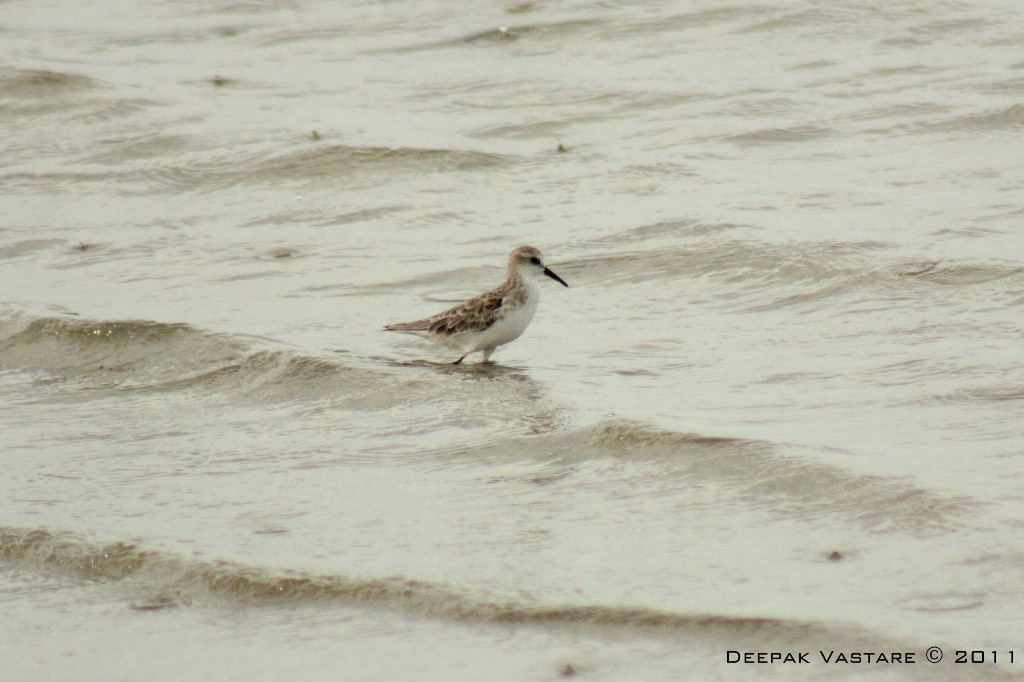
Among the various waders, this Little Stint was the most fascinating! With a size smaller than a House Sparrow, it undertakes great migration breeding in the Arctic and wintering in South Asia and Africa!

Little Stint
Along with the water birds, there was a lot of scope with land birds as well, in the woods nearby. The limelight however was this rare, alluring land bird which was playing hide and seek with us most of the time, showing off its chestnut colors for a brief moment and disappearing the next. Finally it decided to pose for us for long enough for us to appreciate its beauty – The Chestnut Winged Cuckoo!!
Chestnut Winged Cuckoo

The other cuckoos seen were Indian Plaintive cuckoo, Lesser cuckoo and Common Hawk Cuckoo.
Indian Plaintive Cuckoo
Black headed cuckoo-shrike female
Not a common hawk cuckoo as we thought earlier, after comments from Hemant and observing again a) beak b) eyes c) the wing pattern we have corrected it.

And the Blue faced Malkohas had never before been this co-operative, waiting patiently for us, for minutes at times at close quarters.

Blue faced Malkoha
Asian Paradise Flycatcher - Juvenile

We had also been to Udayamarthanda puram another wetland nearby where we saw huge flocks of ibises, herons, storks, egrets, pelicans and other birds. All were returning home at sunset, in numbers reaching thousands.

Apart from birding, we were also taught a few lessons in bird ringing, something that BNHS station folks are doing, studying about the migration pattern of the birds. Personally, we didn’t like the idea of bringing the birds to the Field Station for the sake of ringing. Felt it would rather be better to ring the birds close to the place where they are captured and release them immediately, like how it is done in Europe.  But nevertheless, it was something to learn about the ways and means of scientific study of bird migration.
Red necked Phalarope
Bar tailed Godwit
Below is the bird list and Do enjoy the pics, this trip report is due for almost an year and we are glad that we eventually made it.


Bird list
  • Tern, Caspian
  • Tern, Gull-billed
  • Gull, Brown-headed
  • Gull, Heuglin’s
  • Curlew, Eurasian
  • Darter
  • Egret, Cattle
  • Egret, Intermediate
  • Egret, Large
  • Egret, Little
  • Heron, Black-crowned Night
  • Heron, Grey
  • Heron, Indian Pond
  • Heron, Purple
  • Bittern, Cinnamon
  • Flamingo, Greater
  • Ibis, Black-headed
  • Ibis, Glossy
  • Pelican, Spot-billed
  • Spoonbill, Eurasian
  • Stilt, Black-winged
  • Stork, Painted
  • Lapwing, Red-wattled
  • Coot, Common
  • Cormorant, Little
  • Shag, Indian
  • Shoveller, Northern
  • Moorhen, Common
  • Grebe, Little
  • Swamphen, Purple
  • Duck, Spot-billed
  • Waterhen, White-breasted
  • Sandpiper, Broadbilled
  • Sandpiper, Common
  • Sandpiper, Curlew
  • Sandpiper, Wood
  • Greenshank, Common
  • Redshank, Common
  • Plover, Greater Sand
  • Plover, Grey
  • Plover, Kentish
  • Plover, Lesser-sand
  • Plover, Little Ringed
  • Plover, Pacific Golden
  • Stint, Little
  • Stint, Temminck’s
  • Phalarope, Red-necked
  • Godwit, Bar-tailed
  • Godwit, Black-tailed
  • Falcon, Peregrine
  • Harrier, Western Marsh
  • Kite, Black
  • Kite, Black-shouldered
  • Kite, Brahminy
  • Francolin, Grey
  • Babbler, Jungle
  • Babbler, White-headed
  • Barbet, White cheeked
  • Bee-eater, Blue-tailed
  • Bee-eater, Green
  • Bulbul, Red-vented
  • Bulbul, White-browed
  • Malkoha, Blue-faced
  • Cuckoo-shrike, Black-headed
  • Cuckoo, Chestnut-winged
  • Cuckoo, Common Hawk
  • Cuckoo, Indian Plaintive
  • Cuckoo, Lesser
  • Cuckoo, Pied Crested
  • Koel, Asian
  • Dove, Eurasian Collared
  • Dove, Laughing
  • Dove, Spotted
  • Drongo, Black
  • Flycatcher, Asian Paradise
  • Hoopoe, Common
  • Kingfisher, Common
  • Kingfisher, Pied
  • Kingfisher, White-throated
  • Owlet, Spotted
  • Pigeon, Blue-rock
  • Pigeon, Orange-breased Green
  • Bushlark, Indian
  • Pipit, Paddyfield
  • Pipit, Richard’s
  • Prinia, Ashy
  • Robin, Indian
  • Robin, Oriental Magpie
  • Roller, Indian
  • Shrike, Brown
  • Shrike, Long-tailed
  • Skylark, Oriental
  • Sparrow, House
  • Sunbird, Loten’s
  • Sunbird, Purple
  • Sunbird, Purple-rumped
  • Swallow, Common
  • Swift, Asian Palm
  • Treepie, Rufous
  • Wagtail, Large Pied
  • Warbler, Blyth’s Reed
  • Woodswallow, Ashy
  • Parakeet, Rose-ringed
  • Peafowl, Indian
  • Starling, Brahminy
  • Mynah, Common
  • Coucal, Greater
  • Crow, House
  • Crow, Large-billed
 And some sighted mammals


Black Buck
Spotted Deer
Wild Boar
and Finally Our Car - left Stranded


Wishing you all a great 2013 and happy and sane birding during the year. Comments and Corrections welcome as always.

Sunday, September 30, 2012

Witnessing the great Migration @ Falsterbo - Sweden


Imagine yourself sitting on a sea coast with a cup of hot coffee, looking up the sky. Every minute you see waves after waves of birds, in huge numbers, crossing over your head. By huge, we mean not tens not hundreds, not even thousands - it is tens of thousands on a single day! Would it not be a delight for a bird watcher to do this kind of birding? Well, it is not a fantasy; it’s about a place called Falsterbo where this happens almost every day in autumn. Birds leaving Scandinavia before winter, cross this place in numbers as big as a few millions. To be in Scandinavia and not to visit Falsterbo, especially in autumn would be a great sin for a birder! We knew this is the place to go in autumn. 

Black Headed Gulls, heading South West
About Falsterbo: 
Falsterbo is an anvil shaped peninsula on the South westernmost part on Sweden. It is said to have formed about 10000 years ago during the end of the last Ice age when the glaciers retreated and left behind a series of moraine hummocks. Over thousands of years, shifting sands emerged in between and eventually the small anvil-shaped peninsula formed as we see it today.

A flock of Barnacle Geese
It is estimated that about 500 million birds leave the Nordic countries every autumn, migrating to the south, some diurnal and some nocturnal and some both. Out of these, in Falsaterbo alone, 1-3 million diurnal migrant birds have been counted. On a clear day it would be a delight to watch flocks after flocks of various species of birds, flying in various sized flocks, or some even loners, and at various altitudes. Autumn migration here starts in July itself, when it is still Summer and goes on till almost November. And throughout the season, there are different species migrating, some early and some late. With Scandinavian weather being highly varied and hardly predictable, the migration on a particular day largely depends on the weather conditions suitable to that bird. 

A huge flock of Wigeons

Why Falsterbo?
For migratory birds, it is a matter of compulsion to migrate to a better place mainly for availability of food supply. Since they will be faced with many threats on their way like lack of food, resting place, becoming preys, large expanses of sea, bad climatic conditions and many more, they often choose a safe path as far as possible.  

A flock of Canada Geese
Land based birds on autumn migration fly as far as possible along the coast, heading south west and they reach the Swedish west coast and since they try to avoid huge expanses of sea, they eventually get channeled to Falsterbo peninsula. From here, the birds have no choice but to venture out over the sea to reach the next land mass.

More facts about bird migration:

Green Finches resting after a meal of fruits

 - We learnt that passerines mostly migrate by the night for various reasons which includes being safe from raptors. And they typically take shelter in Falsterbo lighthouse garden at day break before continuing on their journey forward. 

Blue Tit - a partial migrant
 - Raptors usually migrate in the middle of the day, when the sun is high up in the horizon, using thermals to soar up in the sky. It is said that in right thermal conditions, buzzards can soar and cover a distance of up to 12 km without a single wing beat; and for eagles it is up to 20km! Birders at Falsterbo call the time between 12 to 1pm as ‘Eagle hour’ because if at all raptors are to be spotted, they will be during that hour.

A Marsh Harrier soaring high up in the sky

 - Since we chose early-autumn (early September), we got a mix of passerines, water birds, a few waders and raptors.  

A Green Shank


A Bar tailed Godwit

European Honey Buzzards - A Juvenile and an adult
 - There was a continuous flight of Honey Buzzards and Marsh Harriers, not in huge flocks, but in singles, pairs and groups of threes and fours.

Another Honey Buzzard

- It was raining Sparrow Hawks! Everywhere we saw, there surely was a Sparrow Hawk or two; some migrating, some residents. It was as if they were following us everywhere we went, right from the moment we landed in Falsterbo!

Sparrowhawk
 - Some of the raptors like Merlin, Hobby and Osprey were lifers for us! 

Eurasian Hobby in a high speed flight!

An Osprey


Merlin  Female Marsh Harrier ( distinguishing marks: long tail and a creamy head )
 - Geese were arriving and departing in flocks after flocks, making loud calls in their typical V-formation

Geese in classic V-formation
 - We didn’t spot any Owls in the woods, though we longed to see them. We were told that they were in huge numbers the previous year, and as a result rodent population had reduced drastically. However the reduced rodent population meant that there was no food supply for Owls now and they too have almost vanished from the place.

A Collared Dove
 - Weather in Scandinavia predictably highly unpredictable! The days we chose were not the best of the days in terms of number of birds, it was a great experience nevertheless.

A few more Canada Geese
 - The ornithologists at ‘Falsterbo Fagel Station’ are doing a wonderful job, studying the bird migration here and ringing the birds. Two people stand at the prime point Nabben, from dawn to dusk, despite the harsh weather, meticulously noting down the bird species and counting each species. Note that on days with great weather, this count can be a few hundred thousand too!

 - And seasoned birders, who have been studying the migration from decades, stand in front of the lighthouse, another good point for witnessing migration, from morning till late afternoon, just guiding amateur birders like us, helping with Ids and sharing fascinating bird facts. That was something greatly appreciated.

A White Wagtail in the Golf Course adjoining the Light house garden
 - Coming to bird ringing, trapping, ringing and releasing birds requires handling them with utmost care and it was amazing to see the dedication with which it was done. The birds were handled as soon as they were trapped, and the ringing done right at the same spot, and released, all in a matter of a few minutes, making sure the bird is not held for longer than necessary.

A Robin, after ringing
 - We could rent bicycles there and cover most of the birding areas in Falsterbo and Skanor. A sign we spotted while riding… feels good to see that little creatures are regarded too :). There were other signs of Avocets crossing roads, as well!

{Information Source - The book 'Wings Over Falsterbo' and knowledge gained through talks with the experts there. 
Some of the pics were shot in low light conditions and have been over exposed, so as to show the colors of the plumage, rather than being right photographically :) }

Bird List:
Swan, Mute
Heron, Grey
Geese, Barnacle
Geese, Canada
Geese, Graylag
Mallard
Wigeon, Eurasian
Teal, Eurasian
Duck, Tufted
Shelduck, Common
Gadwall
Goosander
Cormorant, Great
Eider, Common
Buzzard, Common
Honey Buzzard, European
Merlin
Marsh Harrier, Eurasian
Sparrowhawk, Eurasian
Osprey
Kestrel, Common
Hobby, European
Merlin
Coot, Common
Oyster Catcher, Eurasian
Lapwing, Northern
Godwit, Bar tailed
Redshank, Spotted
Greenshank, Common
Gull, Herrings
Gull, Black Headed
Gull, Common
Gull, Black Backed
Pigeon, Stock
Pigeon, Wood
Dove, Eurasian Collared
Swift, Common
Martin, House
Barn Swallow
Woodpecker, Spotted
Lark, Sky
Robin, European
Wagtail, White
Wagtail, Yellow
Pipit, Tree
Redstart, Common
Warbler, Willow
Warblers, Un-Id’ed
Flycatcher, Spotted
Tit, Great
Tit, Blue
Tit, Coal
Raven / Rook ?
Jackdaw, Eurasian
Crow, Hooded
Starlings, European
Magpie, Eurasian
Sparrow, House
Sparrow, Eurasian Tree
Chaffinch
Finch, Rose
Finch, Green
Linnet, Common
Siskin, European


Finally a Metal Bird!
We must say few words about the people at Falsterbo who have been studying bird migration over many years now. They are doing really a wonderful job out there which was an eye opener for us. They have been maintaining everyday reports of all birds sighted and their respective counts from ages. It can be found here.

Some serious Birders at Falsterbo

‘Wings Over Falsterbo’ is a book which is about bird migration at Falsterbo but also contains many interesting facts about bird migration in general! This book is co authored by many reputed ornithologists and greatly benefited us!

We are grateful to people at Falsterbo Fagelstation who made this possible for us!!! A BIG THANK YOU FOLKS!!